DIY project management
How People Actually Manage DIY Projects: From Notebooks to Trello
Most people use several tools at once. The difficult part is keeping the connections between tasks, parts, costs and project history.
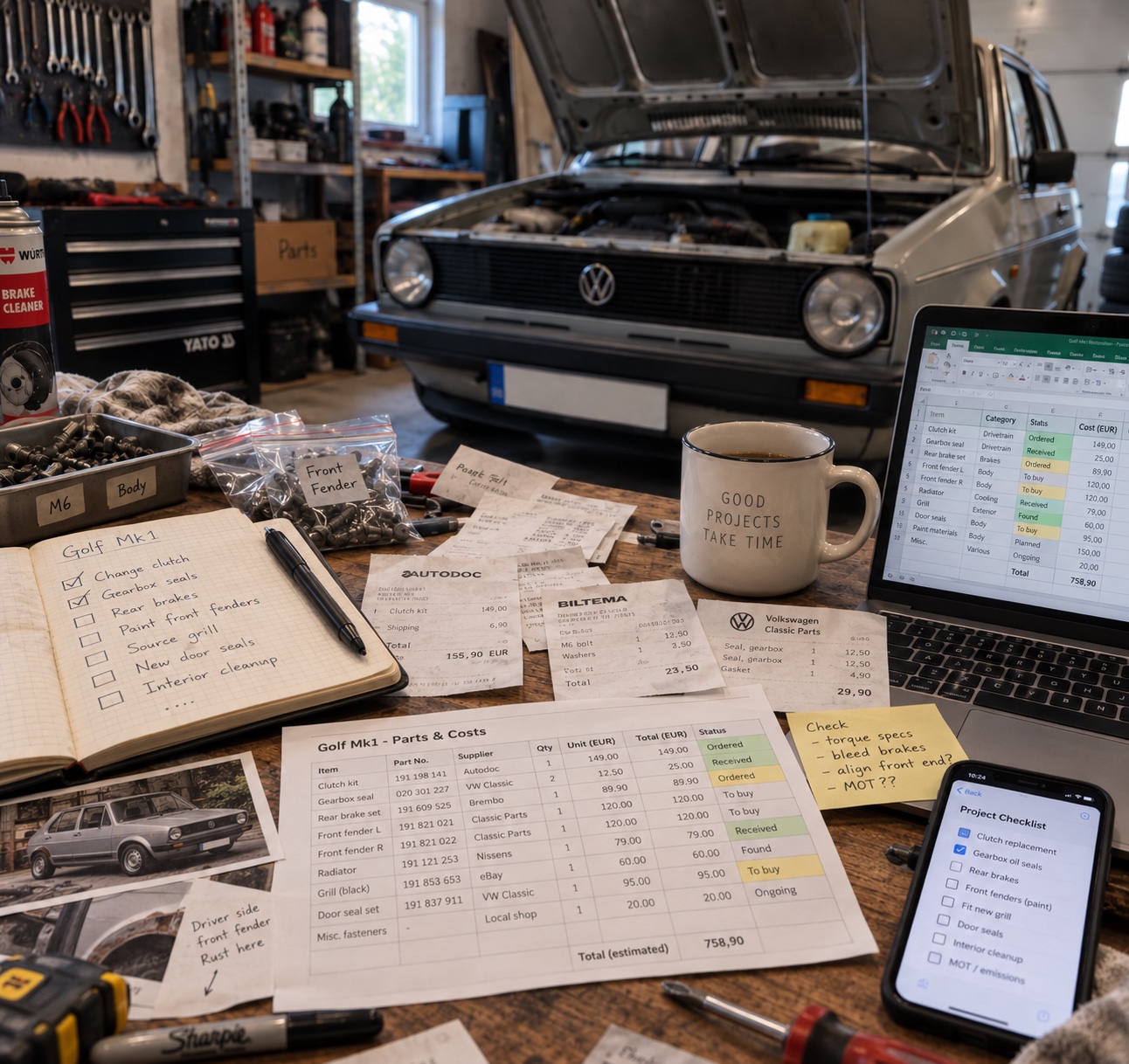
How people keep long-running DIY projects organized with notebooks, photos, spreadsheets, Trello and Notion — and where those tools start to fall short.
A one-evening job rarely needs project management. But restoring a car, renovating a room or building a workshop can take months or years.
Eventually it becomes hard to remember what was done, which parts were bought, what to order next and why a decision was made months ago. Looking at how project-car owners and DIY enthusiasts describe their process, one pattern stands out: most do track their projects, but across several tools at once.
Memory, notebooks and a garage whiteboard
Keeping the work in your head is fine while the project is moving. After a long pause, it becomes harder to remember why a part was removed, whether a seal was ordered or what had to happen before reassembly.
Notebooks, cardboard lists and whiteboards are natural tools because they live where the work happens. They are excellent for the question “what should I do next?”, but a weak archive for “what happened six months ago?”, costs and parts history.
Notes keep information, not always structure
Phone notes quickly collect part numbers, dimensions, links, ideas and shopping lists. Over time, one long note mixes bodywork, suspension, completed jobs and untested ideas.
Photos document the process
Photos are often more important than text in a physical project: they record wiring, the state of metal and the contents of parts bins. Without a link to a job or assembly, though, many similar teardown photos are hard to interpret a year later.
Spreadsheets are great for parts and money
Excel and Google Sheets make it easy to track part numbers, prices, order status and expenses, often in separate sheets for the engine, suspension, body and tools.
They become strained when they must also show work sequence, dependencies and parts waiting time. At that point, people start building a project-management app inside a spreadsheet.
Trello makes work visible
Cards, checklists, photos and columns such as Ideas, To Do, In Progress, Waiting for Parts and Done help make work visible and reduce the feeling that something was forgotten.
But a generic task manager does not know how a suspension rebuild relates to its parts, materials, tools, cost and a specific assembly. The owner still has to model those connections.
Notion lets you build your own system
Notion can connect projects, tasks, parts, expenses, work logs and photos, but that flexibility comes with setup and maintenance.
A build log preserves project history
A forum build thread or social-media series records the starting point, problems, solutions and result. It answers “what did I do?” better than “what should I do next?”, so it is a project history rather than a working plan.
One project usually lives in several systems
A common setup is a whiteboard for next jobs, phone notes for purchases, a spreadsheet for costs, photos for teardown, folders for manuals and receipts, and a public log for the story. Each tool works well at its own job.
The gaps are the hard part: a photo has no task, a bought part loses its reason, an expense has no assembly, and “assemble suspension” does not say whether every required part has arrived.
What these systems are trying to preserve
- work to do
- parts, materials, tools and services
- statuses
- notes, photos and decisions
- costs
- connections between them
You do not have to choose between paper and an app
A digital system does not need to replace the garage whiteboard, phone camera or paper label on a fastener box. Those tools are still the fastest at the bench.
What a long project needs is a connected history of the object, its projects, stages, tasks, parts, costs and completed work. If a project has acquired a board, notebook, spreadsheet, photo folder and phone shopping list, it may be time to connect that context.